

The Law Against Generosity
On the fantasy of the "pure giver"
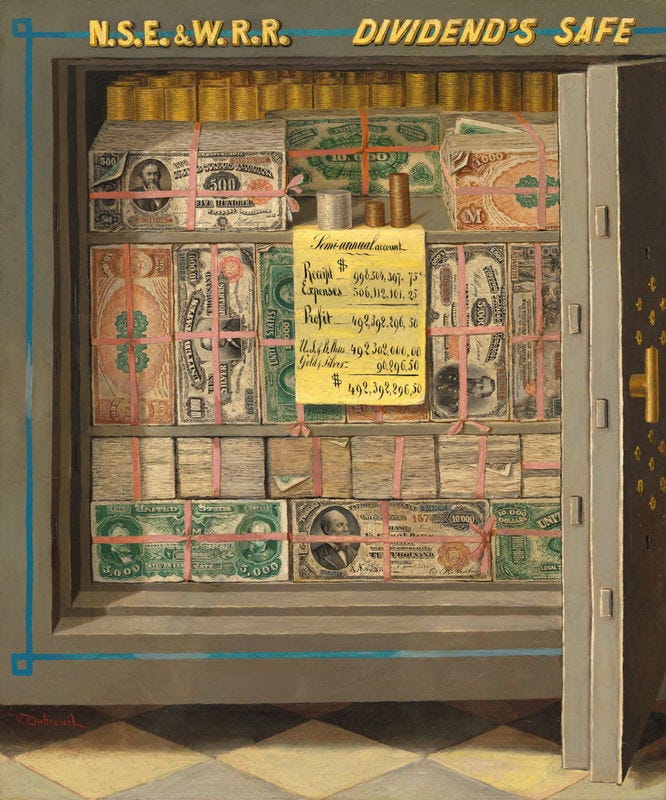
You aren’t to regularly give more than a fifth of your income to charity, according to halacha. The question is: Why? Judaism seems less ambitious in this than the modern selflessness, wired for total self-sacrifice for causes far less than feeding a beggar, like saving all life on earth. Acts of kindness support the world, tzedaka is the mitzvah, central to Judaism. Yet somehow, even in this, bourgeois moderation appears to prevail. The noble argument that the money in your pocket could save lives through malaria nets in Africa, and it is thus immoral to have any extra money in your pocket, does not seem to rise to the level of Pikuach Nefesh (abrogating the usual law to save a life) required to waive the limit. How could we ever practically talk about 20% when lives hang in the balance somewhere in the world?
We’ve discussed how so much contemporary “altruism” is in fact sociopathic, how rational commitment to good causes is a type of self-extension, a reflection of our insecure need for immortalization:
“Caring for others” has become an activist, collective, and ideological pursuit…a cudgel and a crowbar, accusing the uncaring and demanding that they abandon their complacency. At the extremes, the officially caring can be cruel, cold, and rageful…[But] they care much more than we do. Their whole being is caring. So how are we to live with them?…
…All these cheap knockoffs of altruism define the other person in ever-more-narrow and comfortable terms, then congratulate themselves for their external commitments. In truth, their commitment is only ever an extension of their worldview…their “other” is only ever that aspect…willing to receive from and subjugate itself to that ideology…These are conditions ripe for the birth of ideology-in-itself…for people to become mouthpieces for ideas that move behind their eyes, their selfhood exiled, a human sacrifice.
That’s not the Kitzur Shulchan Aruch’s reasoning, however:
The commandment is fulfilled in its excellence when you give a fifth in the first year from the principal, and every year after that, a fifth of the profits. You should not give away more than a fifth, so that you will not become dependent on others.
It says that a person who gives more than a fifth is placing themselves at risk of needing charity in the future. Avoiding becoming a burden, it says a few laws later, is a great virtue: “He should suffer hardship rather than depend on people.” When thinking of others, one must also consider those who may one day need to support us because of our magnanimity.
We can read this as the same point about altruism. To properly commit to others, we must first think about ourselves. Crucially, “ourselves” doesn’t mean our theories or understanding of the world or how to act as a “good person.” The law teaches us to think of ourselves as dependent beings who may very well become contingent on others’ monetary donations if we aren’t careful. This may be why in Tanya (Iggeres HaKodesh, Chapter 10), the Alter Rebbe writes that in repentance, a Jew can go above and beyond and give away more than a fifth. He should give more specifically because he is contrite and realizes that he requires mercy beyond the natural order, and so must give of his possessions beyond the natural order as well.
Tanya’s encouragement to give more isn’t contrary to the law at all, but its continuation. The law asks us to see ourselves not as crusaders or givers of any kind, but as a receiver. “Think of the others implicit in your own finitude and lack of self-sufficiency.” Tanya echoes what the Kitzur says at the beginning of the chapter:
A person should consider that he continually requests his sustenance from the Holy One blessed is He; and just as he requests that the Holy One blessed is He, listen to his cry and prayer, so should he listen to the cry of the poor. A person should also consider that [fortune] is a wheel that revolves in the world, and in the end, he or his children or his children’s children might [have to] accept charity.
This is perhaps the simplest way to avoid becoming a sociopathic altruist. Our deepest self, beyond our own conceptions, is one with the people. No idea from my own head can be total or all-consuming, for my head emerged from a womb, and my being emerged from my people, and my body shall be washed by my family before it is returned to the dust of Jerusalem.