

“Where is G-d?”
A First Yechidus on the Brooklyn Pavement
One of the most remarkable exchanges with the Rebbe is described in a Living Torah interview. It is an event out of time, a first yechidus occurring not in a candle-lit study in Liadi but on the all-too-real streets of Brooklyn. Elliot Lasky is a Jew born in a DP camp after the holocaust who strayed from his traditional Jewish upbringing to immerse himself in the world of Rock and Roll. Despite pursuing other forms of spirituality, he feels that something is missing. In 1973, during a personal crisis, he has a brief encounter with the Lubavitcher Rebbe on the street outside of 770. The entire interview is remarkable, but this is the core moment:
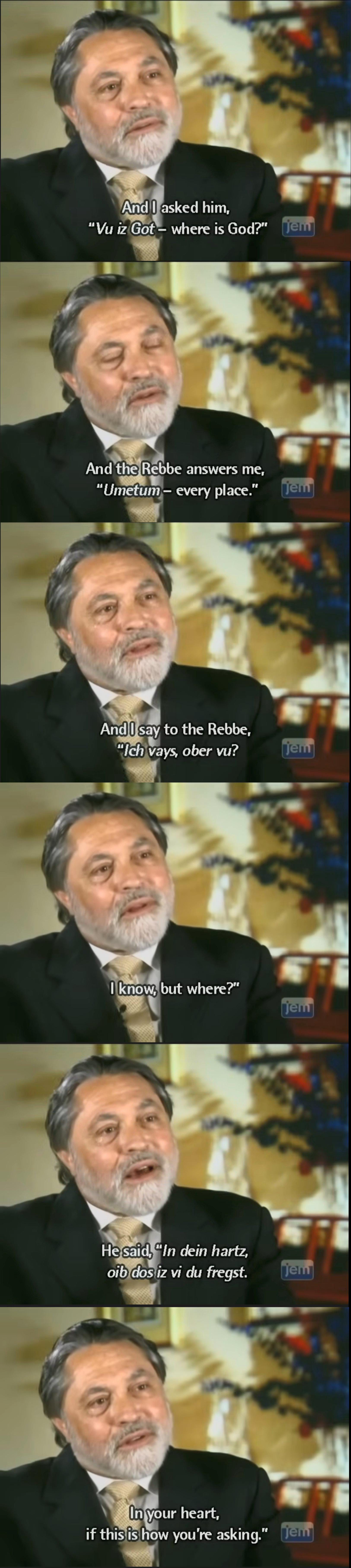
The first step, as it was in Liadi, is to know that G-d is everywhere. G-d is the only true reality, and all other realities are lesser and real only inasmuch as they depend on G-d. In a real sense, dependence on G-d is all there is other than G-d Himself. The world is a function of Him rather than vice versa. Hashem is here, Hashem is there, Hashem is truly everywhere. This was once more difficult to accept, mostly because other intellectual commitments limited G-d, made of him an idea, and excluded that idea from the world.
But the Jew meeting the Rebbe on the streets of Brooklyn doesn’t have as much of a philosophical problem with G-d’s omnipresence. Yes, he says, but where is He? In other words, sure, He’s everywhere, but that doesn’t satisfy me. If He’s everywhere, why is this world what it is? Why is my life what it is? Why am I who I am? If He’s everywhere, and I even accept that, then why do I feel like I’ve never met Him?
Reader, I think this is the question to which the whole Chassidus is an answer, a question from the depths of the Jew’s being, a question to which the Alter Rebbe writes the Tanya as an answer. I think this because the Rebbe’s answer is the first chapters of Tanya: If this is how you’re asking, then G-d is already inside your own heart. Your question is itself His signature. You need more than G-d being everywhere because even more than He is everywhere, He is inside you. You’re a Jew. You didn’t choose it and can’t escape it.
Perhaps this is the entire Tanya on one foot. If we are a Jew not as a function of history or accident but as our constitutive identity, if everything can be explained in terms of it, then we can meet G-d. We can truly know that He is everywhere. It will take a lot of work, but with this in hand, the rest is commentary. To his credit, Elliot Lasky went and learned.
Great post